|
|
HOW PASSOVER became EASTER
By Rabbi Mike Short
Part One
|
|
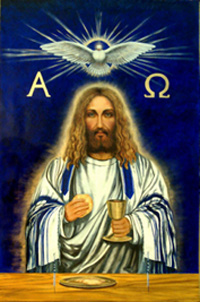
This wonderful picture of the Messiah during the Feast of Passover, His last Passover, where He is teaching His Disciples how Passover relates to Him was painted by Ann Chapin of the East Coast USA. She has given me her gracious permission to use it in this article. Ann is a Catholic believer in the Messiah and friend who I met on the Internet through another wonderful friend from South Africa, Pastor Cornelius Claassen. Ann is one of the most talented artist I have ever met, her work shows how she allows the Rauch HaKodesh (Holy Spirit) to guide her. This painting was for a Catholic Man's retreat and shows the Messiah doing what is known in the Church as the Lord's Supper, but in fact is the third cup of the Passover Seder; known as the Cup of Redemption. The wafer is the "Afikoman" from the Passover Seder; this unleavened matzo is broken into two large pieces, one is wrapped in a linen cloth, hidden away until after the dinner has been eaten. Then a child retrieves it, a ransom is paid to get it back from the child, and then it is broken into small pieces and given to every member of the Seder. Today in Jewish circles it takes place of the sacrificial Lamb and is considered the dessert! But this article isn't just about Passover; it is about this wonderful Feast of the Lord being replaced by Pagan Easter. To read more about the Messiah during this time, you go to the Book of Matthew; Chapter 26, also Luke 22.
During this time of year we have the Jewish Feast of Passover and the Christian Easter, which is really a festival of fertility named after the Babylonian Goddess Isthar or some spell it Ashera or Eastre and as you will see there are other spellings also. So then the celebration and worship of the goddess of fertility with the symbolic use of the egg as a focal point and is known as Easter and has nothing to do with the resurrection of the Messiah. Here's a question for you, does the Bible make any references to 'Egg'? Of course as always I have an answer for you, yes it does, once in the Tanach and once in the New Testament:Job 6:6 Can that which is unsavoury be eaten without salt? or is there any taste in the white of an egg?
Luke 11:12 Or if he shall ask an egg, will he offer him a scorpion?
But for the life of me I can't see how that tells me I should in any way connect this to the resurrection of the Messiah!
How about Easter do we have any New Testament scriptures that state we should celebrate Easter? There is only ONE reference in the entire Bible and in only the KJV that even mentions Easter and that is Acts 12:4 and here the word should be Passover, the Strong's definition is as follows for KJV-Easter, Passover. NT:3957 pascha (pas'-khah); of Aramaic origin [compare OT:6453]; the Passover (the meal, the day, the festival or the special sacrifices connected with it):
Wow! Does any Christians know this you might ask, well I decided to look at some Christian Commentaries on this verse and I have enclosed a couple, following is part of an article from the International Standard Bible Encyclopaedia referring to Acts 12:4, I will include the whole article a little later as it will answer part of the question "How Passover became Easter" and a reference from Jamieson, Fausset, and Brown Commentary on Acts 12:4
EASTER
(es'-ter) (pascha, from Aramaic paccha' and Hebrew pecach, the Passover festival): The English word comes from the Anglo-Saxon Eastre or Estera, a Teutonic goddess to whom sacrifice was offered in April, so the name was transferred to the paschal feast. The word does not properly occur in Scripture, although the King James Version has it in Acts 12:4 where it stands for Passover, as it is rightly rendered in the Revised Version (British and American). There is no trace of Easter celebration in the New Testament, though some would see an intimation of it in 1 Cor 5:7. The Jewish Christians in the early church continued to celebrate the Passover, regarding Christ as the true paschal lamb, and this naturally passed over into a commemoration of the death and resurrection of Our Lord, or an Easter feast. (from International Standard Bible Encyclopaedia, Electronic Database Copyright (c)1996 by Biblesoft)
Acts 12:4
And when he had apprehended him, he put him in prison, and delivered him to four quaternions of soldiers to keep him; intending after Easter to bring him forth to the people.
[And when he had apprehended him, he put him in prison, and delivered him to four quaternions of soldiers to keep him]-that is, to four parties of four each, corresponding to the four Roman watches; two watching in prison and two at the gates, and each party being on duty for the space of one watch.
[Intending after Easter], [meta (NT:3326) ta (NT:3588) pascha (NT:3957)]-it should be, `after the Passover:' that is, after the conclusion of the festival. (The word employed in our King James Version being an ecclesiastical term of later date, is improperly used here.) (from Jamieson, Fausset, and Brown Commentary, Electronic Database. Copyright (c) 1997 by Biblesoft)I just had to include one more reference by a Christian Commentary
Acts 12:4
And when he had apprehended him, he put him in prison, and delivered him to four quaternions of soldiers to keep him; intending after Easter to bring him forth to the people. [And when he had apprehended him] When he had taken or arrested him. [He put him in prison] During the solemnities of this religious festival, it would have been deemed improper to have engaged in the trial of a supposed criminal. The minds of the people were expected to be devoted solely to the services of religion; and hence, Herod chose to retain him in custody until the Passover had ended. [To four quaternions of soldiers] A "quaternion" was a company of "four"; consequently the whole number employed here was sixteen. The Romans divided the night into four watches so that the guards could be relieved; those who were on guard occupying three hours, and being then relieved. Of the four who were on guard, two were with Peter in the prison (Acts 12:6), and two kept watch before the door of the prison. The utmost precaution was taken that he should not escape; and Herod thus gave the most ample assurance to the Jews of his intention to secure Peter, and to bring him to trial. [Intending after Easter] There never was a more absurd or unhappy translation than this. The original is simply after the Passover meta (NT:3326) to (NT:3588) pascha (NT:3957). The word "Easter" now denotes the festival observed by many Christian churches in honor of the resurrection of the Saviour. But the original has no reference to that, nor is there the slightest evidence that any such festival was observed at the time when this book was written. The translation is not only unhappy, as it does not convey at all the meaning of the original, but because it may contribute to foster an opinion that such a festival was observed in the time of the apostles. The word "Easter" is of Saxon origin, and is supposed to be derived from Eostre," the goddess of Love, or the Venus of the North, in honor of whom a festival was celebrated by our pagan ancestors in the month of April (Webster). Since this festival coincided with the Passover of the Jews, and with the feast observed by Christians in honor of the resurrection of Christ, the name came to be used to denote the latter. In the old Anglo-Saxon service-books the term "Easter" is used frequently to translate the word "Passover." In the translation by Wycliffe, the word "paske," that is, "Passover," is used. But Tyndale and Coverdale used the word "Easter," and hence, it has very improperly crept into our King James Version.(from Barnes' Notes, Electronic Database. Copyright (c) 1997 by Biblesoft) Bold highlights are mine to point out this very important point!
It is quite clear that the Church knows or should know all about this, so why is it that it is never taught in the Church. I wish I had an answer to that; I had a Pastor friend ask me just a couple of weeks ago. "Just what is Pagan about Easter?" I explained it to Him, now this is an educated man with a degree from a very good Bible School, but it also VERY clear that the Bible Schools are not teaching the origin of the Holidays. Does this man love God? You had better believe it, He is a very fine Pastor and I love Him dearly, I have no reservations about calling on Him for prayer or anything. He was being very honest with me and really wanted to know. I also told my sister-in-law that I was writing this paper and She said to me, "I wish I had known all this a long time ago, but it was never taught in the Church." I also wish that I had known about it a long time ago! We celebrated Easter and Christmas like all other believers. I have colored many, many Easter eggs until I was taught the difference so then I went to Yeshiva (Hebrew School) and was taught what the Bible really says.
There is a very good article about Easter on the website www.ReligiousTolerance.org that I recommend looking at, they go into some of the same things that I will be sharing here and I will be including some of their references.
So then how did this all come about? In an earlier paper I talked about Sunday replacing the Shabbat (Sabbath). The origin is the about the same, it started when Gentile Believers wanted to replace the Feasts of the Lord with Pagan holidays. In 196 C.E. there was a council in Caesareria, the first council without Messianic Jewish Believers in attendance. The Council ruled that "resurrection day" would thereafter be observed on the pagan holiday of "Easter".
The following is from Rabbi Doctor Mikha'el Snidecor's Doctoral Thesis:
"Then the Catholic Church father Saint Appathanies wrote that those of Jewish origins, who defile the Church by the observance of the Jewish feasts and festivals, were "heretics" and should not be allowed inside the Church. This and other statements forced the "Jewish question" that being, should anything "Jewish" be observed by those of Jewish origin who had become "Christians"? The answer to this question and others came via the Council of Nicea in the year 325 C.E. and later via the Council at Antioch wherein those of Jewish ancestry were told to cease all things "Jewish" to include circumcision, Jewish religious training, all feasts and festivals. Close on the heels of this order came the uniform change to Sunday as the day of worship, throughout the Roman Empire as Constantine and the Bishop of Rome, later known as the "Pope" reached agreement."
So then today we know that Modern-day Easter is derived from two ancient traditions: one Judeo-Christian and the other Pagan. Both Christians and Pagans have celebrated death and resurrection themes on or after the Spring Equinox for millennia. Most religious historians believe that many elements of the Christian observance of Easter were derived from earlier Pagan celebrations. (part of this is from the website).
There are many references to the Pagan origin of Easter; some used are almost humorous if it wasn't so tragic. One of these is about a Pagan god Attis, I will include a part of the write up on the website mentioned earlier in this paper.
Many, perhaps most, Pagan religions in the Mediterranean area had a major seasonal day of religious celebration at or following the Spring Equinox. Cybele, the Phrygian fertility goddess, had a fictional consort who was believed to have been born via a virgin birth. He was Attis, who was believed to have died and been resurrected each year during the period MAR-22 to MAR-25. "About 200 B.C. mystery cults began to appear in Rome just as they had earlier in Greece. Most notable was the Cybele cult centered on Vatican hill ...Associated with the Cybele cult was that of her lover, Attis ([the older Tammuz, Osiris, Dionysus, or Orpheus under a new name). He was a god of ever-reviving vegetation. Born of a virgin, he died and was reborn annually. The festival began as a day of blood on Black Friday and culminated after three days in a day of rejoicing over the resurrection."
Now the humorous part; Wherever Christian worship of Jesus and Pagan worship of Attis were active in the same geographical area in ancient times, Christians "used to celebrate the death and resurrection of Jesus on the same date; and pagans and Christians used to quarrel bitterly about which of their gods was the true prototype and which the imitation."
Many religious historians believe that the death and resurrection legends were first associated with Attis, many centuries before the birth of Jesus. They were simply grafted on to stories of Jesus' life, in order to make Christian theology more acceptable to Pagans. Ancient Christians had an alternate explanation; they claimed that Satan had created counterfeit deities in advance of the coming of Christ in order to confuse humanity. Modern-day Christians generally regard the Attis legend as being a Pagan myth of little value. They regard Jesus' death and resurrection account as being true, and unrelated to the earlier tradition.
According to the website article and the Bible the Judeo-Christian traditions come from the background of Passover. The following is an excerpt from the website, as is most of the above with some of my commentary.
The Christian celebration of Easter is linked to the Jewish celebration of the Passover. Passover and the Feast of Unleavened Bread were observed by the ancient Israelites early in each new year. (The Jewish people followed the Persian/Babylonian calendar and started each year with the Spring Equinox circa MAR-21) "Equinox" means "equal night;" on that date of the year, the night and day are approximately equal. The name "Passover" was derived from the actions of the angel of death as described in the book of Exodus. The angel "passed over" the homes of the Jews which were marked with the blood obtained from a ritual animal sacrifice. The same angel exterminated the first born son of every family whose doorway was not so marked - one of the greatest acts of mass-murder mentioned in the Bible.
I disagree with the term mass-murder but every person has the right to state how he or she feels about the workings of God. So then how did we get around to worship rabbits and eggs? That of course comes from a Pagan Ritual associated one of the names of the goddess Isthar. Each Country has their own name for the goddess of fertility. The symbols of the Norse Goddess Ostara were the hare and the egg. Both represented fertility. From these, we have inherited the customs and symbols of the Easter egg and Easter rabbit.(website)
Dyed eggs also formed part of the rituals of the Babylonian mystery religions. Eggs "were sacred to many ancient civilizations and formed an integral part of religious ceremonies in Egypt and the Orient. Dyed eggs were hung in Egyptian temples, and the egg was regarded as the emblem of regenerative life proceeding from the mouth of the great Egyptian god." Anon, "Easter: The Pagan Origins of Common Easter Traditions"
Some of the other Easter Traditions are just as seeped in Paganism as the rabbit and egg, how about Easter Lilies. This is also from the website "The so-called 'Easter lily' has long been revered by pagans of various lands as a holy symbol associated with the reproductive organs. It was considered a phallic symbol!" A. J. Dager, "Facts and Fallacies of the Resurrection," Page 5. Cited in: R.K. Tardo, "Rabbits, Eggs and Other Easter Errors"
I will include one more tradition used from the website, Easter Candles: These are sometimes lit in churches on the eve of Easter Sunday. Some commentators believe that these can be directly linked to the Pagan customs of lighting bonfires at this time of year to welcome the rebirth/resurrection of the sun God.
The website even goes into the sun rise services and other traditions used in Easter services which I will skip here, as what has already been type should be sufficient to show that Easter is Pagan.
So what is the next step? Well there are at least two points I want to make; one is how Easter came into being by decree and two that Passover is Biblical and did the early believers celebrate it with references in the New Testament. Point two could be broken down to many different steps, so maybe I won't count the points and just go until I have completed this task.
How did Easter become to replace Passover, so let's begin by including some references to show how this all came about. I will start with some excerpts from Rabbi Doctor Mikha'el Snidecor’s of Jerusalem Doctoral Thesis for the Geneva Theological Seminary of London entitled "Messianic Perspectives". Doctor Snidecor is a friend of mine and we have discussed these points over and over. I, along with another friend spent a month with Doctor Snidecor in Jerusalem where we not only toured the Country of Israel by bus; we studied scriptures and ideas along this manner almost on a daily basis. I truly believe that Jerusalem is the best City in the World to study the Bible!THE BISHOP OF ROME, CONSTANTINE AND GREEK SCRIPTURE
We know that the Bishop of Rome, later known as the "Pope" did establish a working relationship with Constantine and while we may never know the substance of that meeting, we do know that immediately thereafter we find the Church and State acting in unison with each other. With this in mind none were surprised when "Constantine, at the great Council of Nicaea (325 C.E.), backed up the claims of the western bishops, and urged the following reason for this measure: 'Let us, then, have nothing in common with the Jews, who are our adversaries...Therefore this irregularity must be corrected, in order that we may no more have anything in common with the parricides and murderers of our Lord'" [Kiesz, John. A HISTORY OF THE SABBATH & SUNDAY. Fairview, Oklahoma: The Bible Sabbath Association, N/A.]
"The spirit that would utterly repudiate the Sabbath of the Lord, which the Jews observed, at least nominally, is shown in Constantine's letter, regulating the time of the celebration of Easter, after the Council of Nice. Said he "Let us then have nothing in common with the detestable Jewish crowd" [Life of Constantine, book 3, chapter 18] [Waggoner, E.J. SUNDAY: THE ORIGIN OF IT'S OBSERVANCE IN THE CHRISTIAN CHURCH. Oakland California: Pacific Press Publishing Company, 1891]
"At the Council of Nicea, exhibiting unwarranted hatred of the Jews, as Emperor of Rome, Constantine established his infamous 'Easter Edict,' cursing and cutting off all Believers who would dare follow any traditions of the hated 'Jews' [Hargis, David. THE CONSTANTINE CONSPIRACY White Stone, Virginia: House of David Herald, 1994.].
"At an earlier canonization it had been decided that only Luke's gospel, after it had been 'purged' of its Judaisms, and ten likewise 'purged' letters of the apostle Paul were to be considered canonical"
[Fricke, Weddig. THE CORT-MARTIAL OF JESUS: A CHRISTIAN DEFENDS THE JEWS AGAINST THE CHARGE OF DEICIDE. Berlin: Grove Weidenfeld, 1990].
"Not until 383 C.E. was and end put to the confusion when Pope Damasus I commissioned his secretary Hieronymus (St Jerome) to revise the ancient Latin Bible translation. The result was another Latin work, the Vulgate, containing the twenty seven writings that henceforth were regarded as the canon of the New Testament" [Fricke, Weddig. THE COURT-MARTIAL OF JESUS: A CHRISTIAN DEFENDS THE JEWS AGAINST THE CHARGE OF DEICIDE. Berlin: Grove Weidenfeld, 1990].
Constantine, the moving force behind the translation and production of the first "Bible" (a collection of writings) has this to say, "Let us, then, have nothing in common with the hostile rabble of the Jews" [Carlow, George. A DEFENSE OF THE SABBATH.NewYork,Paul Stillman publisher, 1847].
Mosheim, in his Ecclesiastical History says that Council of Laodicea was motivated in it's edicts solely by "hatred of anything that savored of the Jewish religion" [Waggoner, E.J. SUNDAY: THE ORIGIN OF IT'S OBSERVANCE IN THE CHRISTIAN CHURCH. Oakland California: Pacific Press Publishing Company, 1891].
"Bower simply mentions the fact that a deputation of bishops visited Constantine and were consulted by him in (311 C.E.), which was before he left Gaul, and that one of them was Hosius of Cordova" [Waggoner, E.J. SUNDAY: THE ORIGIN OF IT'S OBSERVANCE IN THE CHRISTIAN CHURCH. Oakland California: Pacific Press Publishing Company, 1891].
"Constantine was never anything but a pagan, regarding Christ as one of the gods and himself as another" [Waggoner, E.J. SUNDAY: THE ORIGIN OF IT'S OBSERVANCE IN THE CHRISTIAN CHURCH. Oakland California: Pacific Press Publishing Company, 1891].
In the latter part of the fourth century the Council of Laodicea enacted the following canon "Christians shall not Judaize and be idle on Saturday, but shall work on that day; but the Lord's day they shall especially honor, and as being Christians, shall, if possible, do no work on that day. If, however, they are found Judaizing, they shall be shut out from Christ." ' This was in harmony with Constantine's sentiment that they ought not to have anything in common with the detestable Jews' [Waggoner, E.J. SUNDAY: THE ORIGIN OF IT'S OBSERVANCE IN THE CHRISTIAN CHURCH. Oakland California: Pacific Press Publishing Company, 1891].
The spirit that prevailed at the Council of Laodicea and it's edicts was a "hatred of anything that savored of the Jewish religion" [Waggoner, E.J. SUNDAY: THE ORIGIN OF IT'S OBSERVANCE IN THE CHRISTIAN CHURCH. Oakland California: Pacific Press Publishing Company, 1891].
"The Pope and Emperor of Rome had two great problems in order for their new world religion to succeed. They had to get rid of the Other Bible (Hebrew Scriptures) and to destroy the Oldest church (the Jerusalem Movement) in the world that was at Jerusalem which was the Mother Church of Christianity. A Jewish Church with Jewish preachers, deacons, elders, bishops, apostles, and missionaries; all of the family of Jesus through His mother, Mary...a meeting took place in the year 318 A.D....between Pope Silvester and the eight Jewish leaders...the Pope sent his ship to Israel and Antioch and then back to the port of Ostia...we know that Joses was the oldest of the Jews in the group of leaders called the Desposyni (belonging to the Lord)...Every part of the Ancient Jewish Church has always been governed by a Desposyni, and each of them is a blood relative of Jesus. There were three blood relative descendants from Jesus' own family on His Mother's side only. One from Joachim and Anna, Jesus' maternal grandparents. One from Elizabeth, first cousin of Jesus' Mother, Mary, and Elizabeth's husband, Zachary. One from Cleophas and his wife, who also was a first cousin of Mary" [Parker, D.L. THE OTHER BIBLE. Elbert, Colorado: D.L Parker Ministries, 1989].The Desposyni had three requests of Silvester:
1) We want our Bishop over us and not one from Rome, and he will be a Desposyni.
2) We want all Jewish believers to send money to the Mother Church in Jerusalem because this is the Mother Church of Christianity.
3) Lift the Hadrian ban so Jews can live in Jerusalem.
Silvester with the backing of Constantine, dismissed the claims of the Jewish believers and ordered: "The Mother Church was now in Rome with the bones of the Apostle Peter and you will accept a Greek Bishop to lead you. It was the last known discussion between the Jewish believers of the Old Mother Church in Jerusalem and the new Mother Church in Rome under Peter and the Pope" [Parker, D.L. THE OTHER BIBLE. Elbert, Colorado: D.L Parker Ministries, 1989]. End of article
From this we can see that a lot more than just Easter and Sunday worship was at stake here. The total control of the Jewish Church, which was started by the direct disciples of the Messiah, was now in the hands of Gentiles from Rome. It was nothing like the Jerusalem Council where Paul defended the Gentile believers before the predecessors of this very same group.
And as promised I will now insert the article on Acts 12:4 from the International Standard Bible Encyclopaedia that's show how this was changed and how Easter is calculated.
EASTER
(es'-ter) (pascha, from Aramaic paccha' and Hebrew pecach, the Passover festival): The English word comes from the Anglo-Saxon Eastre or Estera, a Teutonic goddess to whom sacrifice was offered in April, so the name was transferred to the paschal feast. The word does not properly occur in Scripture, although the King James Version has it in Acts 12:4 where it stands for Passover, as it is rightly rendered in the Revised Version (British and American). There is no trace of Easter celebration in the New Testament, though some would see an intimation of it in 1 Cor 5:7. The Jewish Christians in the early church continued to celebrate the Passover, regarding Christ as the true paschal lamb, and this naturally passed over into a commemoration of the death and resurrection of Our Lord, or an Easter feast. This was preceded by a fast, which was considered by one party as ending at the hour of the crucifixion, i.e. at 3 o'clock on Friday, by another as continuing until the hour of the resurrection before dawn on Easter morning.
Differences arose as to the time of the Easter celebration, the Jewish Christians naturally fixing it at the time of the Passover feast which was regulated by the paschal moon. According to this reckoning it began on the evening of the 14th day of the moon of the month of Nican without regard to the day of the week, while the gentile Christians identified it with the first day of the week, i.e. the Sunday of the resurrection, irrespective of the day of the month. This latter practice finally prevailed in the church, and those who followed the other reckoning were stigmatized as heretics. But differences arose as to the proper Sunday for the Easter celebration which led to long and bitter controversies. The Council of Nice, 325 AD, decreed that it should be on Sunday, but did not fix the particular Sunday. It was left to the bishop of Alexandria to determine, since that city was regarded as the authority in astronomical matters and he was to communicate the result of his determination to the other bishops. But this was not satisfactory, especially to the western churches, and a definite rule for the determination of Easter was needed. By some it was kept as early as March 21, and by others as late as April 25, and others followed dates between. The rule was finally adopted, in the 7th century, to celebrate Easter on the Sunday following the 14th day of the calendar moon which comes on, or after, the vernal equinox which was fixed for March 21. This is not always the astronomical moon, but near enough for practical purposes, and is determined without astronomical calculation by certain intricate rules adopted by ecclesiastical authority. These rules involve the Dominical Letters, or the first seven of the alphabet, representing the days of the week, A standing for the first day of the year and the one on which Sunday falls being called the Dominical for that year. There are also involved the Golden Numbers and the Epacts, the first being the numbers from 1 to 19, the cycle of the moon when its phases recur on the same days of the year, the first of the cycle being that in which the new moon falls on January 1. The Epacts indicate the moon's age at the beginning of each year. Easter was thus fixed by these rules, but another difficulty arose when the Gregorian calendar was adopted in 1582, the difference between it and the Julian being then 10 days. This of course affected the determination of Easter, and its celebration by the Greek church, which has never admitted the Gregorian calendar, occurs usually at a different time from that followed by the western churches. This difference may be as much as five weeks and it may occur as late as April 30, while in the West it cannot occur later than April 25 nor earlier than March 22. Occasionally the two come together but this is rare, since the difference between the two calendars is now 13 days. The Easter feast has been and still is regarded as the greatest in the Christian church, since it commemorates the most important event in the life of its Founder. [H. PORTER] (From International Standard Bible Encyclopaedia, Electronic Database Copyright (c)1996 by Biblesoft)
I am sure by now that you are wondering if I celebrate the resurrection of the Messiah, well the answer is yes, but at the time when it should be celebrated, that is the Feast of First Fruits which is the Sunday following Passover. This year (2001) the feast should fall on the Sunday that is set aside as Palm Sunday, which is the correct day for First Fruits. And I hope you are also wondering if this cycle of Paganism will ever be broken or better yet what you can do to help break it! I believe that the resurrection of the Messiah is as important as the article from the International Standard Bible Encyclopaedia states, because without the resurrection He would have died in vain and could have been labeled as one more Messiah in a long line of Messiah's.
I think that we have reached the end of point one, and with the evidence shown to the jury (you) we can safely say "guilty!" Easter is guilty of being a Pagan Holiday and rabbit's and eggs have no connection to the resurrection of the Messiah. Easter the Pagan is guilty of replacing Passover one of the Feast of God. In other words Christendom has set one of its Sabbaths above one of the Sabbaths of God.
How do you think God feels about this, where we set up our own Sabbaths; let’s look at His Word in part two of this article.
"How Passover Became Easter"
Part TwoIf you would like to write Rabbi Mike Short with your comments, click the Torah Scroll:
***********************************************************************************

Mayim's Endnote