From the Ancient Hebrew Prayer Book
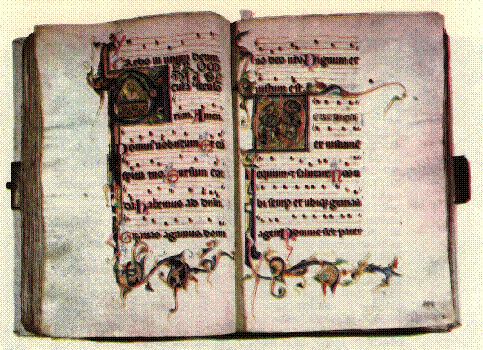
The prayer you are about to read is found in a Machzor, a Rosh Hashanah/Yom Kippur prayer book. This prayer is found in several Machzor's (Festival Prayer Books), put out by the Hebrew Publishing Company from the years 1928 to 1931, as well as one from the 13th century. This 13th century Machzor, is in the Hamburg State Library, therefore this prayer is Ancient! In this prayer, we read some wonderful things about the person of the Messiah (Anointed):
"Our righteous Anointed is departed from us: horror has seized us, and we have none to justify us. He has borne the yoke of our iniquities, and our transgression, and is wounded because of our transgression. He bears our sins on his shoulders, that we may find pardon for our iniquities. We shall be healed by the wound, at the time that eternal will create the Messiah as a new creature, O bring him up from the circle of the earth. Raise him up from Seir, to assemble us the second time on mount Lebanon, by the hand of Yinon." 1 --Note: Click the following link for a scanned pdf file of the orginal 1928 Machzor. Don't believe it? See for yourselves.
What we have in this wonderful prayer is a commentary on Isaiah, chapter 53. As we look closely at this awesome ancient prayer, we can see the beliefs of the ancient Sages and Rabbis. These Sages and Rabbis believed the Messiah had an assignment. Let us look at that assignment in this prayer.
1. Messiah would then clearly depart after an initial appearance: "Our righteous anointed is departed."
2. The Messiah would then be someone who would vindicate the people: "horror has seized us, and we have none to justify us."
3. The Messiah would be wounded, we must ask why? Because of the our sins (transgression). "He has borne the yoke of our iniquities, and our transgression, and is wounded because of our transgression."
4. Then we read that by "his wound" we would be healed, when he reappears as a "new creature." "We shall be healed by the wound, at the time that eternal will create the Messiah as a new creature, O bring him up from the circle of the earth."
5. Now the prayer is clear, it would be for "a second time." "Raise him up from Seir, to assemble us the second time on mount Lebanon, by the hand of Yinon (Yinnon)."
6. What does Seir, Lebanon, and Yinon mean? Lets deal with them one at a time.(A) Seir - In Genesis 33:14 we see Jacob is returning to his homeland, and he tells his brother Esau, "I will come to my lord (adoni) at Seir." What is so great about this phrase "I will come" which has a Gematria of the number 4, the Dalet, the Door, the Messiah (John 10:7), can be seen in some other writings we will look at. According to The New Englishman Hebrew Concordance, the word "I will come" in Gen. 33:14 are in the "future tense." That is very important for us to know.
Now, this is what the great Rabbi Rashi said: "the Sages explain that Jacob was alluding to end of days, when, as Obadiah prophesied, Jacob's descendants will come to Mount Seir to render judgment against Esau's descendants." Forthwith from The Pentateuch, by J. H. Hertz, second edition, we read in his commentary on Genesis 33:14, "Their is no record that Jacob went to Seir to see his brother. But, add the Rabbis! Jacob will yet visit Esau in the Day of the Messiah, when the reconciliation between Israel and Edom (Hebrew idiom for the Nations) will be complete." This is like two sides of a coin; one side, a picture of judgment, the other is of reconciliation! So we see that the Messiah (the Anointed), Jacob’s descendant, will come from Mount Seir in the end of days, with judgment, and reconciliation!
(B) Lebanon - Lebanon is an Hebrew idiom, or code name, for the Temple of God. The Temple was made of the cedars of Lebanon, hence the idiom for the Temple. (I Kings 5:14-18)
(C) Yinnon (Yinon) - The name Yinnon (Yinon) is one of the ancient Rabbinical names designated for the Messiah of Israel. Sanhedrin 98b tells us this about Yinnon, "His name shall endure for ever" Psalm 72:17. I have also been told, that this name comes from the understanding of the word, Rimmon (Pomegranate). In the Hebrew a pomegranate is a Tree (from its upright growth) which brings forth goodly fruit. Rimmon is another name for the Messiah as well.
If my Jewish people would look to the ancient Sages and Rabbis and the literal interpretation, maybe, just maybe, they would see that Messianic Believers are not wrong in there understanding of Isaiah 53 or the Holy Scriptures. These Scriptures point to who the Messiah was, is, and will be. When Messiah returns, for the second time to the earth, they shall see Him we are told! However, they will mourn because they did not believe He was here before. And the Scriptures proclaim:
"And I will pour upon the house of David, and upon the inhabitants of Jerusalem, the spirit of grace and of supplications: and they shall look upon me (Aleph Tav) whom they have pierced. And they shall mourn for him, as one mourneth for his only son, and shall be in bitterness for him, as one that is in bitterness for his firstborn."2 Zechariah 12:10
The understanding of Isaiah 53 began to change in and around the 11th century common era mostly because of the influence of Rabbi Rashi. He was a respected member of the Midrashim of his day, and many paid heed to his non-literal interpretation of this passage. However, it was not without other Rabbis opposing his views. One such Rabbi was Moshe ibn Cohen Crispin, who in 1336 left his native Cordoba to settle in Toledo, Spain, composed a tract on providence and the afterlife. In this century, Rabbi Moshe ibn Cohen Crispin, who was well known because he adhered to the ancient opinions, stated that to apply the Suffering Servant of Isaiah 53 to the Nation of Israel was a distortion of literal interpretation of the Scriptures. It is interesting that the ancient Machzor is also from this time period. Here is what Rabbi Moshe ibn Cohen Crispin stated:
"distorts the verse of their natural meaning- As then it seemed to me that the doors of the literal interpretation [of Isaiah 53] were shut in their face, and that 'they wearied themselves to find the entrance', having forsaken the knowledge of our Teachers, and inclined after the 'stubbornness of their own hearts' and of their own opinion, I am pleased to interpret it, in accordance with the teaching of our Rabbis, of the King Messiah, and will be careful, so far as I am able, to adhere to the literal sense: thus possibly, I shall be free from the forced and farfetched interpretations of which others have been guilty. This prophecy was delivered by Isaiah at the divine command for the purpose of making known to us something about the nature of the future Messiah, who is to come and to deliver Israel,"
Now, Rabbi Moshe ibn Cohen Crispin did not understand that Yeshua, was the Messiah, and that He had come already. Yet he knew that Isaiah 53 was taking about the person of the Messiah of Israel. He was not the only one who believe this, Rabbi Isaac Abrabanel (1434-1508) also a member in good standing of the Midrashim believed this truth about the person of Messiah. He stated:
"The first question is to ascertain to whom this prophecy refers, for the learned among the Nazarenes expound it of a man who was crucified in Jerusalem at the end of the Second Temple, and, who according to them, was the Son of God and took flesh in the virgin's womb, as is stated in their writings. Jonathan ben Uzziel interprets it in the Targum of the future Messiah; and this is also the opinion of our learned men in the majority of their Midrashim."
Again, because of blindness in part on Israel, they fail to see that Messiah has already come (Deut 28:28; Isaiah 42:20; Matthew 13:13-14; Romans 11:25). It was indeed the Messiah, the Nazarene, who was crucified in Jerusalem at the time frame, the end of the Second Temple period.
Messiah Yeshua will come a second time as He promised in John 14. But why wait to then to receive Him, when you can do it now, by Faith in His words. He calls to all, "Take my yoke upon you, and learn of me; for I am meek and lowly in heart: and you shall find rest for your souls. For my yoke is easy, and my burden is light." Matthew 11:29-30
I put my faith in the literal interpretation of Isaiah 53, as did the ancient Sages and Rabbis did. The prophet Daniel said, the Messiah would be cut off BEFORE the Temple would be destroyed, and that has happened as he spoke it. So when your think about this, you need to ask yourself these questions?
1. If the person of the Messiah was to come before the Temple was to be destroyed in 70 CE/AD, what person fits into that time frame?
2. If Yeshua was the Messiah, why was he sent?
3. If I am a Jew, and Messiah Yeshua was a Jew, will I still be Jewish if I believe in him?
Not to simplify these answers, but to sum up this article, I will answer them.
1. Only Yeshua Messiah fits into the time frame of the Second Temple period. No Messiah could come after the Temple was destroyed. Reading Daniel 9:26-27 we see this: "And after threescore and two weeks shall Messiah be cut off, but not for himself: and the people of the prince that shall come shall destroy the city and the Sanctuary; and the end thereof shall be with a flood, and unto the end of the war desolations are determined. And he (he, the evil prince) shall confirm the covenant with many for one week: and in the midst of the week he shall cause the sacrifice and the oblation to cease, and for the overspreading of abominations he shall make it (Temple) desolate, even until the consummation, and that determined shall be poured upon the desolate. (The Sanctuary i.e. Temple was burned to the ground in 70 CE/AD)
2. Why was Yeshua Messiah sent? It was to make a permanent atonement for his people Israel, and anyone from the nations would believe on God. Genesis 22:8 tells us that "--Avraham said to his son, God will provide Himself a lamb for a burnt offering: so they went both of them together." Because of the faith of father Avraham, the promise for a lamb was provided, but not just then, but in the future. What Avraham said in verse 14 is, Yahvah Yireh will see to it! Yahvah-Yireh, is a symbolical name for Mt. Moriah, the only place that atonement was to be made. This spoken by Avraham was in the "future tense." God in His mercy knew his people needed a permanent atonement, so He Himself provide the lamb. That lamb is Yeshua Messiah, and He is that permanent atonement, the very reason why He was sent is to atone for the sins of mankind. "For God so loved the world, that He gave His only begotten Son, that whoever Believes in Him shall not perish, but have Eternal Life."
3. If I am a Jew, will I still be Jewish if I believe in Yeshua? Yes, Yes, Yes!!! Belief in Yeshua as the Messiah in the 1st century was kosher. It was one of the sects of Judaism (Acts24:5), and it is still that today, only the church at large does not know it! I am more Jewish now then ever before, and God has provide a permanent atonement for my sins, praise His Holy Name. I still do all the Feasts of the LORD, and keep the Saturday Sabbath. I keep it in a way that is such a blessing to my soul, and that it never was to me before. Can you hear the Messiah calling out to you? I can! May God bless all who seek, for surely they will find!
Foot note 1: Some of the information in this article comes from a book by: Dr. Mark Eastman, entitled "The Search For Messiah" - Joy Publishing, and "The Messianic Hope" by: Arthur Kac, his chapter on The Suffering Servant, Isaiah 53.
Foot note 2: In Zechariah 12:10 in the Hebrew text, the letters Aleph Tav appear in the verse. In English you can not see that. The Aleph Tav "ET" is a designation for the Messiah. You could read Zechariah 12:10 this way: "And I will pour upon the house of David, and upon the inhabitants of Jerusalem, the spirit of grace and of supplications: and they shall look upon Me, Messiah, whom they have pierced. And they shall mourn for him, as one mourneth for his only son, and shall be in bitterness for him, as one that is in bitterness for his firstborn."
Shalom,
Rev. Barbara Di Gilio
Mayim Hayim Ministries
Mayim's Endnote